

Submitting a Veterinary Bill: Here's How to Do It Quickly and Easily
If your dog or cat has needed treatment, you probably have enough on your mind. That’s why submitting your vet bill should be as straightforward as possible. By providing a complete bill and a few clear details, you’ll help us review your claim quickly and avoid unnecessary follow-up questions.

Where can I submit my veterinary bill?
You can submit your veterinary bill through the customer portal or the online form.
The easiest way is through our customer portal. There, you can report a vet visit, upload the invoice, and enter the necessary information directly without having to enter your personal details or your pet’s information.
The following applies to both methods: Please submit each invoice to us in a separate submission.
One invoice per report: What does that mean?
Please submit a separate claim for each veterinary bill. This applies even if multiple bills relate to the same medical condition or ongoing treatment.
For example, if you have received one invoice for the initial examination and another for the follow-up visit, submit them in two separate claims. Please do not upload multiple invoices together in a single claim or combine them into a single file.
Good to know: If a single invoice consists of multiple pages, all pages should be included in the same report.
Why not use consolidated invoices or annual summaries?
Save up your veterinary bills and submit them all at the end of the year? That sounds convenient, but it often results in longer processing times and additional follow-up questions.
With consolidated invoices or annual summaries, it is often unclear which services correspond to which treatment. As a result, we have to ask you or your veterinarian’s office for specific details and usually request additional documents, such as medical records and veterinary reports. Processing may be significantly delayed until we have all the necessary information.
If you submit each invoice separately as soon as you receive it, you’ll help us clearly match the treatment to the corresponding costs. This reduces the need for follow-up questions and allows us to review your invoice more quickly. It also helps you keep track of your invoices and ensures you don’t miss the 30-day submission deadline.
Therefore, please submit the detailed individual invoices from your veterinarian’s office in separate claims immediately after each visit. If you only have a consolidated invoice or an annual summary, please ask your veterinarian’s office for the corresponding individual invoices.
When do I need to submit my invoice?
According to our General Insurance Terms and Conditions (GITC), you must submit your veterinary bill as soon as possible after receiving it, but no later than 30 days after receipt.
So don't wait until a course of treatment is completely finished or until you've accumulated several bills. You can report each bill you receive individually right away.
Important: If the deadline is not met, benefits may be reduced in accordance with the General Insurance Conditions.
Our tip: Submit your invoice through the customer portal as soon as you receive it. That way, you won't forget about it in the midst of your daily routine.
Which diagnosis should I select?
When submitting your claim, select the diagnosis that corresponds to the treatment you received. Use the information provided by your veterinarian, as well as the invoice or treatment report, as a guide. Selecting the correct diagnosis helps us process your claim correctly.
How do I describe what happened?
There's no need for a long message. A short, clear description will help us understand why your furry friend was treated. Please answer these questions if possible:
- What symptoms did your pet have?
- When were they first noticed?
- Why did you take your pet to the vet?
- In the Event of an Accident: What Happened and When?
For example:
"Since October 10, Luna has been scratching her right ear frequently. She was examined on October 12. The veterinarian diagnosed an ear infection and prescribed ear drops."
During a follow-up visit, you can briefly indicate which previous treatment it relates to. In the customer portal, you can link it directly by selecting "Follow-up Treatments."
What information and documents are required?
Upload the complete, legible original invoice. According to the General Terms and Conditions, it must include the following information:
- Your pet's name
- Date of Initial Diagnosis and Date of Treatment
- diagnosis
- Veterinary Services Provided and Medications Prescribed
- Invoice amount for the respective service
- Name, address, and phone number of the treating veterinarian
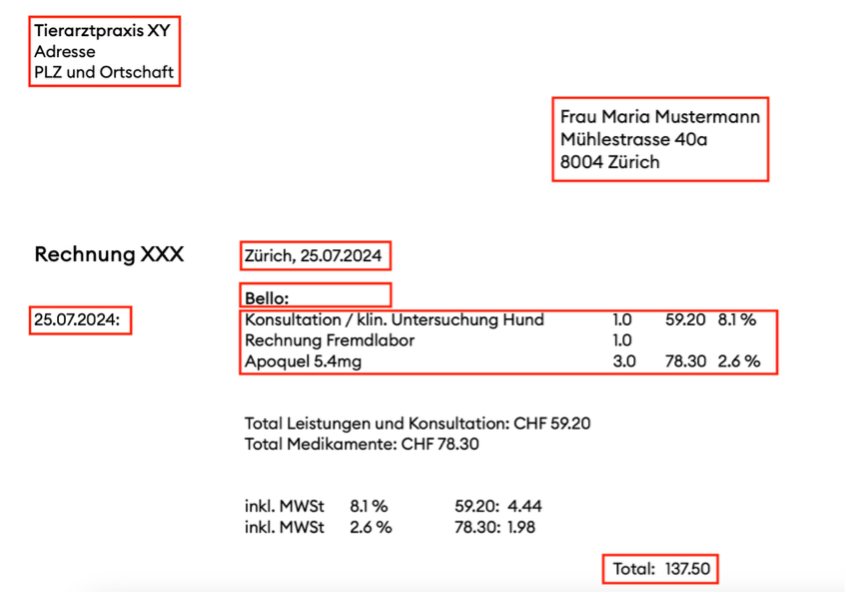
Please also include any relevant supporting documents, receipts, prescriptions, and treatment reports (either as additional pages in the same document or via email to service@calingo.ch). If we need additional documents for our assessment—such as your medical history—we will contact you.
Ready to submit? Here's a quick checklist
- One invoice per submission: Create a new submission for each additional invoice.
- Use individual invoices: Do not submit consolidated invoices or annual summaries.
- Please note the deadline: Report each invoice within 30 days.
- Upload in full: Include all pages of an invoice so that they are clearly legible.
Do you have questions about the submission process? We're happy to assist you.
Do you have any questions about your furry friend's health?
In addition to submitting claims, we’re also here for you and your furry friend in your day-to-day life: With the online veterinary consultation included in your Calingo pet insurance, you get round-the-clock veterinary support via chat, phone, or video. Whether you have questions about symptoms, nutrition, or behavior, our telemedicine service helps you better assess the situation.

According to our General Terms and Conditions of Insurance, this may result in reduced benefits. Therefore, it’s best to submit your invoice through the customer portal immediately after your visit to the veterinarian. That way, you won’t forget about it in the midst of your daily routine, and you won’t have to worry about deadlines.
Please ask your veterinary practice for detailed individual invoices and submit each one in a separate claim. This will allow us to clearly identify each treatment your pet received. As a result, we’ll have fewer questions for you or your veterinarian, and your invoice will be processed more quickly.
Yes. In the customer portal, you can see at any time how far along we are in processing the invoice you submitted. So there’s no need to call or email to check on it.
Follow-up visits are also recorded as separate entries, even if they are related to the same condition. In the customer portal, you can link them directly to the initial treatment by selecting “Follow-up Treatments.” This allows us to see right away how the invoices are related.
Simply email the document to service@calingo.ch. If we need any additional documents for our evaluation—such as your furry friend’s medical history—we’ll get in touch with you.



Dog Insurance for Puppies: The Guide

Cost Comparison of Swiss Dog Insurance Policies in 2026

How to Find Affordable Cat Insurance
From pet parents for pet parents
The health of your furry nose is our job


